
Mini refrigerators are a fantastic way to add extra storage space to your home, office, or dorm room without taking up too much precious real estate. They are incredibly convenient, chill food and beverages in a short amount of time, and possess the same capability to keep your ingredients fresh as a standard unit. all while consuming a fraction of the space and electricity.
If you want to dive deeper into models that skip the freezer compartment entirely, check out the options at homeusetool.
In fact, these compact units are often far more efficient than their larger counterparts, making them the ultimate cooling solution for tight apartments, cozy dorm rooms, and executive offices. But a burning question remains for anyone watching their utility bills: how much power do they actually use?
To figure that out, you need to look at a mini refrigerator’s wattage and amperage ratings. Understanding these metrics helps you determine exactly how much energy a specific unit draws, allowing you to choose an energy-efficient model that won’t spike your monthly expenses.
Depending on the brand and configuration, a mini fridge can range anywhere from a tiny 1.5 cubic feet up to a substantial mid-size model, providing a highly customizable alternative to a full-sized appliance.
The Ubiquitous Kitchen Essential

Walk into any home, and you might see a rice cooker tucked away in a cabinet, or you might not. You might spot a deep fryer sitting on the counter, or you might not. But the one appliance absolutely everyone has plugged in and running is a refrigerator. It is the ultimate, non-negotiable tool of modern living.
Got some leftover pizza to store? Into the fridge it goes. Bought some fresh vegetables that you don’t want to spoil? The crisper drawer is waiting. Is it a scorching hot day and nothing will extinguish your thirst quite like a crisp, ice-cold bottle of water? The fridge has your back.
As you can see, it is an inseparable part and parcel of our daily routine. It is also the only appliance in your household that runs 24/7, year-round.
Because it never takes a break, it’s only natural to wonder: how many amps does a refrigerator use? Or, in simple, practical terms: how much cash is it pulling out of my wallet every month just to keep running?
To answer that accurately, we need to cover a little bit of basic electrical groundwork first.
AC vs. DC Current in Kitchen Appliances
- Direct Current (DC): Current that flows in a single, continuous direction (like power from a battery).
- Alternating Current (AC): Current that periodically reverses direction (the standard power delivered through your home’s wall outlets).
Most of the electronic appliances in your home require an AC outlet. Appliances driven by powerful compressors and motors, like the standard refrigerators used in our homes, run strictly on AC power.
If you are curious about how other culinary gadgets stack up electrically, you can check it out to learn more about kitchen appliance specifications.
So, what exactly does a refrigerator need all this electricity for? The main job is driving the motor inside the compressor, which pumps refrigerant through the cooling coils to maintain that crisp, low temperature inside the unit’s body.
Different refrigerators have different architecture and structural designs to achieve this, directly affecting how much power they draw.
The Different Types of Refrigerators and Their Power Profiles
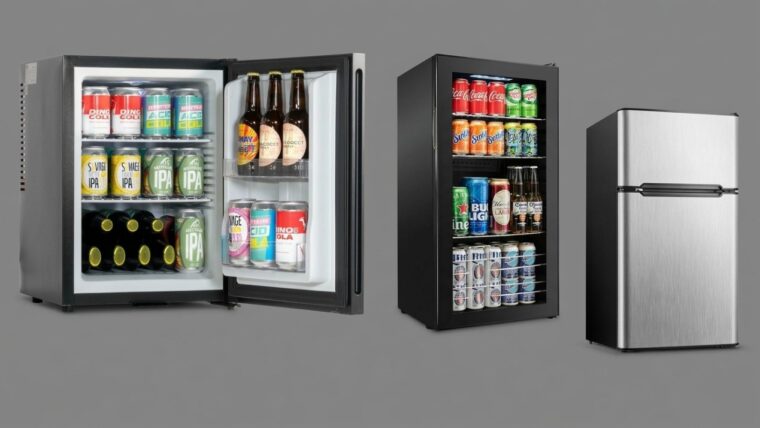
1. Top Freezer Refrigerators
If you have ever stepped foot in a standard suburban home or apartment, you have seen this model everywhere. The classic top-freezer design has dominated the market since appliances became a household staple.
It features a large fresh-food compartment at the bottom and a smaller freezer on top. It is one of the most mechanically simple, reliable, and budget-friendly models available today.
2. Side-by-Side Refrigerators
If you want your fridge to open up like a grand set of double doors welcoming you to food heaven, you are looking for a side-by-side model. These split the appliance vertically, with the freezer on one side and the fresh food on the other.
While they look incredibly sleek, they require a small sacrifice: narrower compartment sizes, meaning you cannot easily store massive pizza boxes or wide catering platters. However, side-by-side units have the benefit of a very narrow door swing radius, making them an excellent choice for tight galley kitchens.
3. Bottom Freezer Refrigerators
Exactly as the name implies, the freezer section is located at the bottom, often pulling out like a large drawer. This layout places the fresh-food items you use most frequently right at eye and arm level.
It provides a massive, versatile block of storage space for both sections, easily accommodating awkwardly shaped dishes or large turkeys.
4. Mini Refrigerators
If you live solo in a studio apartment, want to upgrade your dorm room, or simply need to cut down on utility costs, a compact appliance is your best friend.
The trusty mini fridge takes up minimal physical space, allowing room for other furniture, and uses significantly less raw energy than a full-sized unit.
- With an internal freezer: Features a tiny, dedicated frozen compartment at the top.
- Without a freezer: Dedicated entirely to refrigeration, maximizing fresh beverage and snack storage.
Crucial Factors That Impact Power Consumption
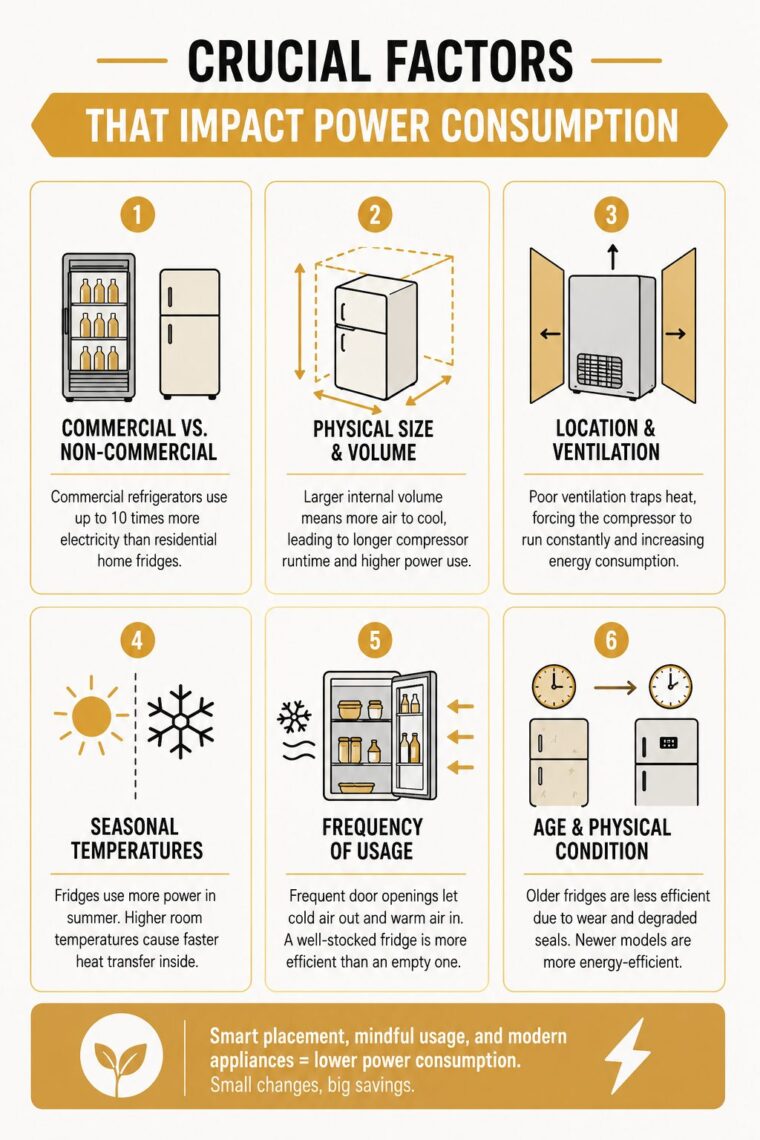
Not every mini fridge or full-sized refrigerator pulls the same amount of power from the wall. Several environmental and physical factors dictate how hard the compressor has to work:
- Commercial vs. Non-Commercial: Commercial refrigerators (like the glass-door beverage coolers in convenience stores) are built with heavy-duty, high-output compressors designed to handle constant opening. On average, a commercial unit uses up to 10 times more electricity than a residential home fridge. Consulting expert guides from this website can help you track down an energy-efficient commercial option if you need business-grade cooling.
- Physical Size & Volume: The larger the internal cubic footage of a fridge, the more air mass it has to keep cool. Bigger areas mean longer compressor runtime and higher overall electricity consumption.
- Location and Ventilation: Refrigerators operate by expelling heat from the inside out into the surrounding room. If you stuff a mini fridge into a tight, unventilated cabinet without proper clearance around the back and sides, the trapped heat will force the compressor to run constantly, skyrocketing your energy bill.
- Seasonal Temperatures: All refrigerators consume more power during the summer months than in the winter. When the ambient room temperature rises, heat leaks into the fridge faster, making the cooling cycles more frequent.
- Frequency of Usage: Every time you open the door, cold air pours out onto the floor and warm room air rushes in. If the door is held open frequently while you decide on a snack, the compressor has to kick into overdrive. Interestingly, a completely empty fridge also works harder than a reasonably stocked one; items like water bottles act as “thermal blocks” that hold onto coldness, preventing rapid temperature swings when the door opens.
- Age and Physical Condition: As a refrigerator grows old, its mechanical parts wear down, seals degrade, and it naturally pulls more energy. Conversely, modern units are engineered under strict modern energy efficiency standards. Newer models feature precise digital thermostats and eco-modes that optimize performance so you never pay for electricity you don’t actually need.
Safety Tip: Always plug high-draw major appliances, even larger mini fridges, into a dedicated wall outlet rather than daisy-chaining them onto flimsy 3-pin extension cords or cheap power strips. This serves as an essential precautionary measure to prevent overheating and potential short circuits.
How Many Watts and Amps Does a Mini Fridge Use?
When we talk about “fridge amps,” we are discussing the measurement of electrical current the refrigerator draws to power its compressor. For standard full-sized household refrigerators, the running amperage typically hovers between 3 to 5 Amps on a standard American 120-volt line.
However, because electric motors require an initial burst of energy to start up, a refrigerator can briefly spike to 15–20 Amps when the compressor kicks on. This is why kitchens require dedicated 15 to 20 Amp circuits.
To figure out the exact amps your specific mini fridge uses, you can utilize Ohm’s Law with a simple math formula:
$$ \text{Amps} = \frac{\text{Watts}}{\text{Volts}} $$
For instance, if a compact 12-volt travel cooler is rated at 60 Watts, its amperage calculation is simple: $60 / 12 = 5\text{ Amps}$ while the motor actively runs.
On the flip side, a large commercial unit drawing high wattage might pull a sustained 15 to 20 Amps continuously.

Comparison of Most Common Mini Fridges
While full-sized residential units run high, mini refrigerators are beautifully economical. The average mid-to-large mini fridge typically uses between 185 Watts and 280 Watts during its active cooling cycle. In terms of kilowatts, that equates to roughly 0.185 kW to 0.28 kW.
Let’s put that into context using standard daily household items to see just how energy efficient these compact units truly are:
| Appliance Type | Average Running Wattage | Kilowattts (kW) |
|---|---|---|
| Standard Incandescent Light Bulb | 40 W – 60 W | 0.04 kW – 0.06 kW |
| Typical Mini Refrigerator | 185 W – 280 W | 0.185 kW – 0.28 kW |
| Full-Sized Domestic Refrigerator | 500 W – 800 W | 0.50 kW – 0.80 kW |
| Standard Household Microwave | 1000 W – 1500 W | 1.00 kW – 1.50 kW |
Because a mini fridge only runs its compressor for roughly 1/3 to 1/2 of the day (cycling on and off to maintain its internal temperature), its actual daily consumption is incredibly low.
Running a standard 200-watt mini fridge typically translates to using roughly less than 1 to 1.5 kilowatt-hours (kWh) per day. At average electricity rates, keeping your drinks cold in a mini fridge costs just a few cents a day, making it an incredibly affordable, highly practical luxury for any living or workspace!